
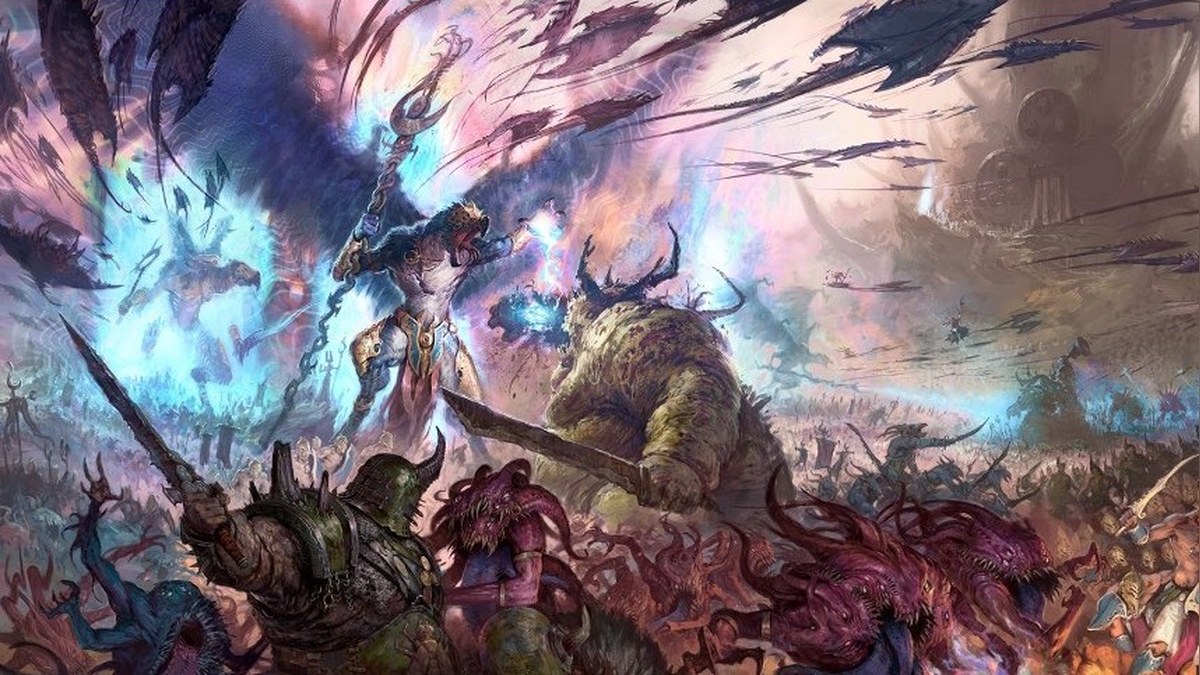
The Chaos Gods are the four great powers of the Warp: Khorne, the god of blood and rage; Nurgle, the god of decay and despair; Tzeentch, the god of change and scheming; and Slaanesh, the god of excess. They are not ancient beings who made the galaxy. Living creatures made them, through every feeling they have ever had. They pull the strings behind traitor Space Marines, daemon armies, heretic cults and most of the galaxy's worst disasters. If you are new to Warhammer 40,000 and keep hearing about "the Ruinous Powers", this page tells you who they are, what they want and why they never stop fighting each other.
Lore page, last updated November 9, 2026. Summarised in our own words from codexes, campaign books, Black Library novels and community wikis. Games Workshop leaves the Chaos Gods mysterious on purpose. In-universe sources lie, contradict each other and are often written by people driven mad, so many "facts" about the gods are rumours or myths. Where the lore differs, we say so.
The Chaos Gods in 30 seconds
| What they are | Huge, living powers born in the Warp from the emotions of living beings |
| Also called | The Ruinous Powers, the Dark Gods, the Chaos Powers |
| The big four | Khorne, Nurgle, Tzeentch, Slaanesh |
| Where they live | The Realm of Chaos, deep inside the Warp |
| Their servants | Daemons, Daemon Princes, Chaos Space Marines, cultists and sorcerers |
| The youngest | Slaanesh, born during the Fall of the Eldar |
| Main goal | Grow stronger, spill into the real galaxy, and beat each other |
| Greatest prize | The four traitor Primarchs who became Daemon Princes |
| Greatest enemies | The Emperor of Mankind and everyone who stands against Chaos |
| Can they be killed? | Not as far as anyone knows. They last as long as the feelings that feed them. |
The four gods side by side
| God | Domain | Sacred number | Colours | Daemons | Greater Daemon | Traitor Legion and Primarch |
|---|---|---|---|---|---|---|
| Khorne | Blood, rage, war, martial pride | 8 | Red and brass | Bloodletters, Flesh Hounds, Bloodcrushers | Bloodthirster | World Eaters, Angron |
| Nurgle | Disease, decay, despair, endurance | 7 | Sickly green and brown | Plaguebearers, Nurglings, Beasts of Nurgle | Great Unclean One | Death Guard, Mortarion |
| Tzeentch | Change, hope, plots, sorcery | 9 | Blue and gold | Pink and Blue Horrors, Flamers, Screamers | Lord of Change | Thousand Sons, Magnus the Red |
| Slaanesh | Excess, pleasure, pride, perfection | 6 | Pink and purple | Daemonettes, Fiends, Seekers | Keeper of Secrets | Emperor's Children, Fulgrim |
What is the Warp?
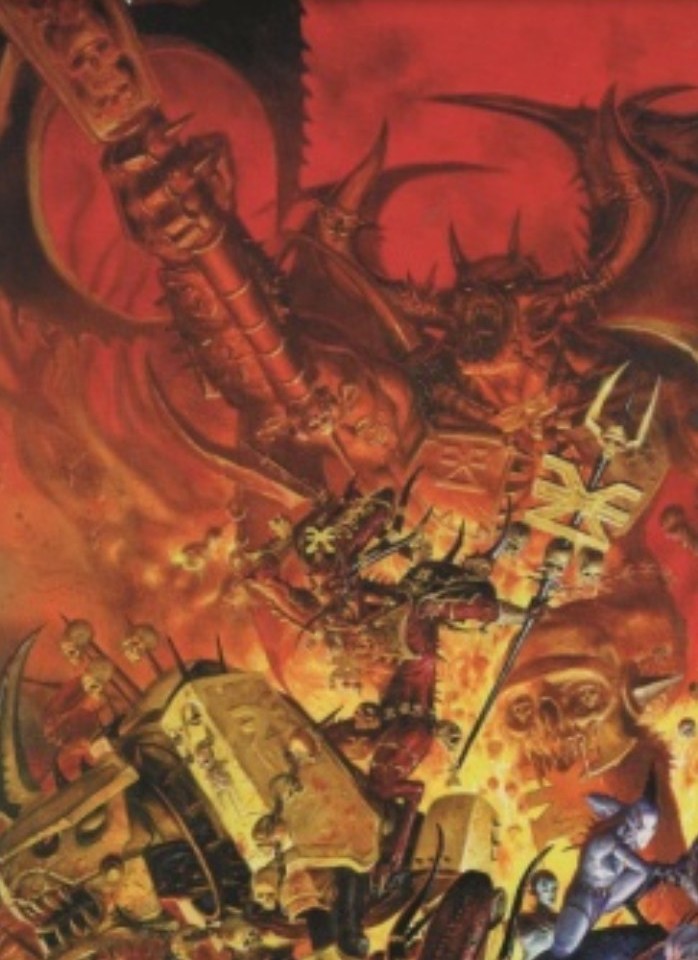
To understand the Chaos Gods you first need to understand the Warp, also called the Immaterium or the Empyrean. It is a parallel dimension that sits "behind" the real universe. It has no solid matter, no fixed time and no normal laws of physics. Instead, it is made of raw psychic energy.
The key idea is this: the Warp reflects the minds of living things. Every time someone in the real galaxy feels something, whether that is anger, hope, fear, lust or grief, it sends a tiny ripple into the Warp. On its own one ripple means nothing. But the galaxy holds countless trillions of thinking beings, and over millions of years their feelings have pooled together like rivers running into a sea.
The Imperium cannot simply avoid the Warp. Starships travel faster than light by diving into it. Psykers, people with psychic powers, draw their abilities from it. The Astronomican, the Emperor's great psychic beacon, shines through it to guide ships. So humanity uses the Warp every day, while knowing that it is full of things that want to eat it.
How the gods were born
When enough of the same feeling builds up in the Warp, it starts to swirl together and take shape. Over a very long time, the strongest of these pools became aware. They gained wills, personalities and appetites. These are the Chaos Gods.
- Every murder, every battle and every burst of fury fed Khorne.
- Every sickness, every fear of death and every stubborn will to survive fed Nurgle.
- Every hope, every ambition and every scheme fed Tzeentch.
- Every indulgence, every obsession and every craving for more fed Slaanesh.
This makes the gods different from gods in most fantasy stories. They did not create the universe. In a sense, the universe created them, and it keeps creating them. The gods need mortals. They feed on mortal feelings, they want mortal worship, and they cannot simply walk into the real galaxy. They need mortals to open the door.
Exactly when the oldest three became aware is never clearly stated. Lore hints that they grew stronger during ancient wars, such as the War in Heaven between the Old Ones and the Necrontyr, but Games Workshop leaves the details vague on purpose. The one god with a clear birthday is Slaanesh, and we will get to that.
Khorne: the Blood God
Khorne is the god of rage, killing and war. He is usually shown as a huge armoured figure sitting on a throne of skulls, on top of a mountain of the skulls of his followers and his victims, inside a brass fortress surrounded by a sea of blood. His followers' war cry is famous across the setting: "Blood for the Blood God! Skulls for the Skull Throne!"
Khorne does not care whose blood is spilled. A follower who kills his enemies pleases him; a follower who dies in battle also pleases him. The only thing Khorne hates is a lack of bloodshed. This is why his warriors can be so terrifying: they do not fear death, because death is just another gift to their god.
There is more to Khorne than mindless slaughter, though. He is also a god of martial honour. He respects strength, courage and a good fight. He despises cowards, and he despises sorcery above almost everything, seeing it as a trick used by the weak. Many of his champions refuse to kill the defenceless, not out of mercy, but because there is no glory in it. Others simply kill everything. Khorne's lore pulls in both directions.
We may earn a commission from links on this page.
His daemons are the Bloodletters, red-skinned horned warriors with burning swords called hellblades, along with the hunting Flesh Hounds and the Bloodcrushers, Bloodletters riding brass-bodied beasts. His Greater Daemon is the Bloodthirster, a winged, axe-wielding monster that is one of the deadliest things in the setting. The most famous is Skarbrand, a Bloodthirster who was cast out by Khorne himself and now burns with endless fury.
Nurgle: the Plague God
Nurgle is the god of disease, rot and decay. That sounds grim, and it is, but Nurgle is also the most cheerful of the four. His followers call him Grandfather Nurgle, and he loves them like a jolly, fat, boil-covered grandparent. He lives in a crumbling manor inside a rotting garden, forever brewing new plagues in his great cauldron.
Nurgle is built from a mix of feelings that seems odd at first. He grows from despair and the fear of death, but also from the stubborn urge to keep going no matter what. Everything that lives will eventually decay, and Nurgle's gift is to make decay a new kind of life. A follower who accepts his diseases stops feeling pain and fear. They become bloated, rotting and almost impossible to kill, and they are oddly happy about it.
His daemons are the Plaguebearers, one-eyed horned daemons who obsessively count and catalogue every disease in the galaxy, the tiny giggling Nurglings, and the slug-like Beasts of Nurgle, who just want to play and accidentally kill everything they touch. His Greater Daemon is the Great Unclean One, a huge, jovial heap of rotting flesh that is surprisingly kind to its followers and horrifyingly cruel to everyone else. Famous ones include Ku'gath Plaguefather and Rotigus.
Tzeentch: the Changer of Ways
Tzeentch is the god of change, ambition, sorcery and fate. He is called the Changer of Ways and the Architect of Fate. He lives in an endless crystal maze, and his body is said to shift constantly, with faces appearing and vanishing across his skin as he speaks.
The surprising thing about Tzeentch is that he grows from hope. Every time someone dreams of a better future, plans to rise above their place or hopes things will change, they feed the Changer of Ways. This makes him dangerous in a quiet way. His cultists are often not brutes, but clever, ambitious people who think they can use his gifts and stay in control.
Tzeentch loves plots. He weaves schemes within schemes, and many of them seem to work against his own goals. Some lore suggests that he is simply playing a longer game than anyone can see. Other lore hints that change for its own sake is the only point. Either way, nobody, not even other gods, can be sure what Tzeentch really wants. He is also the master of sorcery, which makes him Khorne's natural enemy as well as Nurgle's.
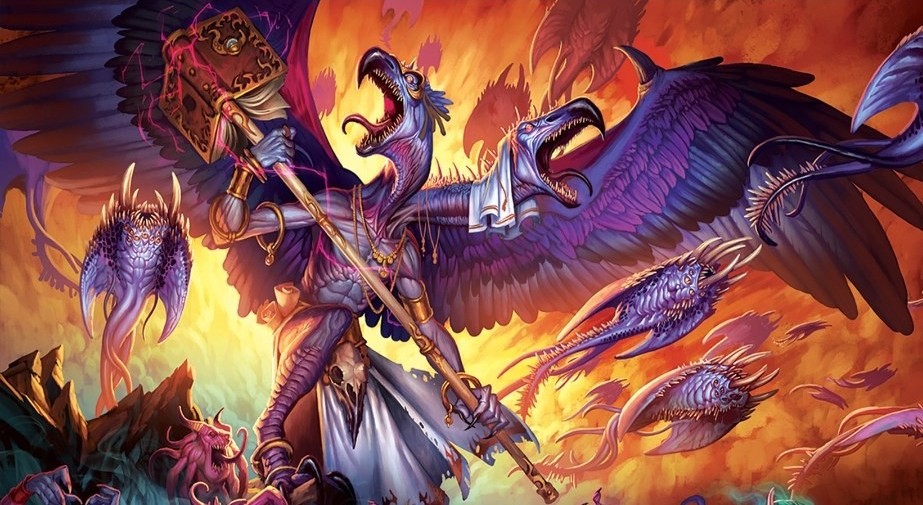
His daemons are the Horrors, which split when they are destroyed (Pink Horrors break into grumpy Blue Horrors, which in turn split into tiny Brimstone Horrors), the fire-spewing Flamers and the flying Screamers. His Greater Daemon is the Lord of Change, a bird-headed giant of sorcery and deception. The most famous is Kairos Fateweaver, a two-headed Lord of Change: one head sees the past, the other sees the future, and they rarely agree.
Slaanesh: the Dark Prince
Slaanesh is the god of pleasure, excess, pride and perfection. They are called the Dark Prince or the Prince of Pleasure, and they are often described as unbearably beautiful, though no two people see them the same way. Slaanesh is about wanting more of anything: more beauty, more sensation, more skill, more praise. A sculptor who will never be satisfied with their work can fall to Slaanesh as easily as a pleasure-seeker.
Slaanesh is the youngest of the four, and the only one with a clear origin. Long ago, the Eldar (now usually called the Aeldari) ruled a vast, rich empire. With no enemies left to fight, their society slowly fell into decadence. They chased every pleasure and every extreme, and over thousands of years their combined obsessions built up in the Warp.
Eventually, a new god was born from all that excess. The moment of birth, known as the Fall, was a psychic explosion that tore the heart out of the Eldar empire. Most of the Eldar race died in an instant and their souls were devoured. A huge wound between the Warp and real space opened where their worlds had been: the Eye of Terror. The surviving Eldar still live in fear, because Slaanesh hungers for their souls above all others.
The Fall also had a big effect on humanity. The terrible warp storms that had cut human worlds off from each other during the Age of Strife were calmed by the birth of Slaanesh. That calm let the Emperor launch the Great Crusade. In other words, a new god of Chaos was born, and in the same moment the door opened for the Emperor's greatest work.
Slaanesh's daemons are the graceful, claw-handed Daemonettes, the scorpion-like Fiends and the Seekers, Daemonettes riding swift, long-tongued steeds. Their Greater Daemon is the Keeper of Secrets, a towering, many-armed daemon of terrible grace who learns every desire of its victims and uses it against them. One famous Keeper is Shalaxi Helbane, a daemon made to hunt down and kill Bloodthirsters.
Slaanesh's war with the Aeldari is not over. One group of survivors, the Ynnari, believe their god of the dead, Ynnead, will one day wake fully and destroy Slaanesh. Fans also often hear that "Slaanesh is missing": that story belongs to Age of Sigmar, where the aelven gods trapped the Dark Prince. In Warhammer 40,000, Slaanesh is still very much at work.
Daemons and Greater Daemons
A daemon is a fragment of a Chaos God's power that has taken on its own shape and will. Lesser daemons are like the god's foot soldiers. Greater Daemons are much larger fragments, generals and favoured servants who can lead entire armies. Each Greater Daemon type matches its god: the Bloodthirster for Khorne, the Great Unclean One for Nurgle, the Lord of Change for Tzeentch and the Keeper of Secrets for Slaanesh.
Daemons cannot normally stay in the real galaxy. They need a doorway, such as a ritual, a possessed host, a psyker losing control, or a region where the Warp has bled into reality. When a daemon's body is destroyed in real space, it is usually just flung back into the Warp. It is not truly killed, only banished. That is why the Imperium fears daemon incursions so much: you can win the battle and still face the same daemon again later.
Mortal champions can also rise into the daemon ranks. A warrior who serves a god well may be rewarded by being made a Daemon Prince, a mortal soul turned into an immortal daemon. Most champions fail long before this, though, and are turned into mindless Chaos Spawn instead.
The Great Game
The four gods hate each other. They are always competing for power, followers and territory in the Warp. This endless rivalry is called the Great Game. Whenever one god grows too strong, the others turn on it, so no single god ever wins outright.
The Game has two natural rivalries:
- Khorne vs. Slaanesh: Khorne sees war as pure and honest. Slaanesh treats even battle as a pleasure to be savoured. Khorne finds this insulting.
- Nurgle vs. Tzeentch: Nurgle stands for decay, endurance and accepting what is. Tzeentch stands for change, hope and plans for a different future. Their natures are direct opposites.
This matters for the whole galaxy. The Great Game is often why Chaos does not simply crush the Imperium. The gods spend as much effort undermining each other as they spend on attacking anyone else. It is also why their followers so often betray each other on the battlefield.
The Daemon Primarchs
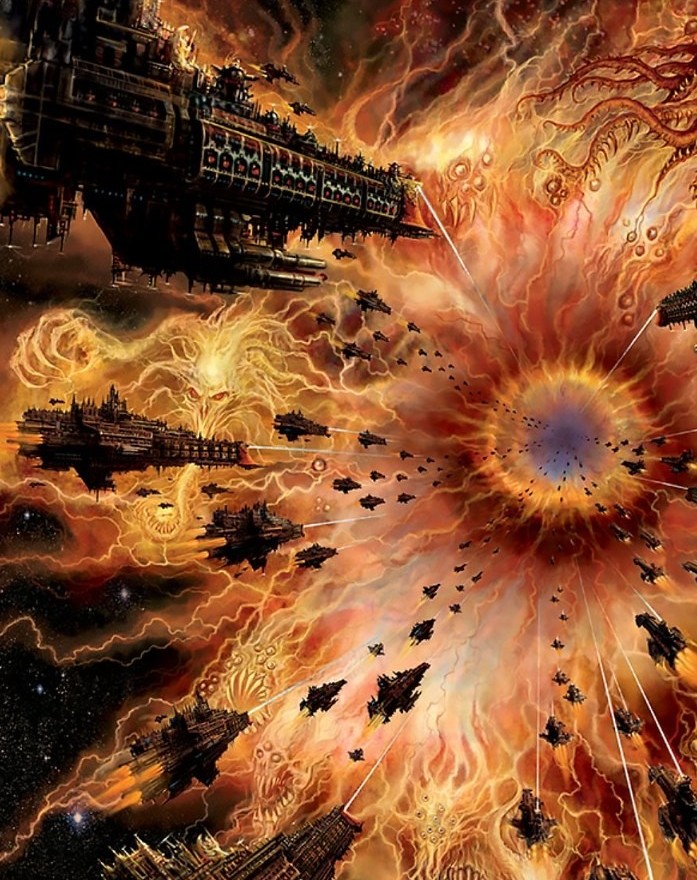
The greatest victory of Chaos came ten thousand years ago in the Horus Heresy, when Horus and half of the Emperor's sons turned traitor. After the war, four of those traitor Primarchs became Daemon Princes, each one claimed by a single god. You can read about all twenty in our guide to the Primarchs.
Angron and Khorne
Angron, Primarch of the World Eaters, was already a wreck of a man, his brain scarred by the cruel implants known as the Butcher's Nails. During the Heresy his brother Lorgar helped raise him to daemonhood, and Khorne took him. Angron became a raging Daemon Primarch of Khorne, and his Legion broke apart into frenzied warbands. The Black Library novel Betrayer tells the story of his fall.
Mortarion and Nurgle
Mortarion, Primarch of the Death Guard, hated sorcery and psykers. Yet when his fleet was trapped in the Warp and his warriors were struck by an unstoppable plague, he gave himself and his Legion to Nurgle to save them. He later rose to become Nurgle's Daemon Primarch, and the Death Guard became the great plague-spreaders of the galaxy.
Magnus and Tzeentch
Magnus the Red, Primarch of the Thousand Sons, was a mighty sorcerer who always believed knowledge could be used safely. His use of sorcery, and his desperate psychic warning to the Emperor, led to his homeworld of Prospero being burned by the Space Wolves. With nowhere else to turn, Magnus gave himself to Tzeentch, who had been guiding his path for a long time. He became Tzeentch's Daemon Primarch.
Fulgrim and Slaanesh
Fulgrim, Primarch of the Emperor's Children, chased perfection in everything. On the world of Laeran he took up a cursed sword that held a daemon of Slaanesh, and it slowly corrupted him. Fulgrim later ascended as Slaanesh's Daemon Primarch, and his Legion became a host of thrill-seekers devoted to excess.
Chaos Undivided
Not every follower of Chaos picks a single god. Many worship all four as a whole, called Chaos Undivided. They see the Dark Gods as parts of one great power, and they try to win favour from all of them at once (or they simply use Chaos as a tool without truly bowing to any one god).
The most famous follower of Chaos Undivided was Horus himself, the Warmaster who led the Heresy. Today his heir, Abaddon the Despoiler, leads the Black Legion under the same banner. Abaddon is a fascinating case: he uses the gods' power, but refuses to become their slave. The novel The Talon of Horus is a great look at how he sees them. If you want to collect an army of his warriors, see our Chaos Space Marines guide.
Minor powers: Malice and the Horned Rat
The big four are not the only powers in the Warp. Lore says there are countless lesser gods and powers, most of which are never named. Two come up often in fan discussions.
Malice, originally called Malal, is a renegade Chaos god who first appeared in very early Warhammer material. He is said to be a god of anarchy who turns Chaos against itself, and the other powers hate him for it. In 40K his best-known followers are a Space Marine warband called the Sons of Malice. He shows up only rarely in modern books, so treat him as a minor footnote.
The Horned Rat is the god of the ratlike Skaven, but he belongs to Warhammer Fantasy and Age of Sigmar, not Warhammer 40,000. Many newer fans hear about him and assume he is part of 40K, so it is worth saying clearly: in Age of Sigmar he has joined the ranks of the great Chaos Gods, but he has no role in the 41st Millennium.
Where to read more
Want the stories behind this page? These are friendly places to start.
- Betrayer (Aaron Dembski-Bowden): Angron's fall to Khorne.
- Fulgrim (Graham McNeill): the Laeran blade and Fulgrim's slide toward Slaanesh.
- A Thousand Sons (Graham McNeill): Magnus, sorcery and the road to Tzeentch.
- The Lords of Silence (Chris Wraight): the Death Guard in the 41st Millennium.
- The Talon of Horus (Aaron Dembski-Bowden): Abaddon and Chaos Undivided.
- Codex: Chaos Daemons: the gods, their daemons and how to field them on the tabletop.
FAQ
Are the Chaos Gods real gods in 40K?
Yes, in the sense that they are real, enormously powerful beings who answer prayers, grant gifts and send daemons. But they are not creators. They were born from the emotions of living beings and depend on those emotions to survive.
Which Chaos God is the strongest?
None of them for long. The Great Game means that whenever one god gets ahead, the others gang up on it. The balance shifts all the time, and the lore deliberately never names a permanent winner.
Why is Slaanesh the youngest god?
Slaanesh was born during the Fall of the Eldar, when thousands of years of Eldar excess finally gave rise to a new god. The birth wiped out most of the Eldar and created the Eye of Terror.
Which Primarchs became Daemon Princes?
Four: Angron for Khorne, Mortarion for Nurgle, Magnus the Red for Tzeentch and Fulgrim for Slaanesh. The other traitor Primarchs either died or found different fates.
What is Chaos Undivided?
It means worshipping all the Chaos Gods together rather than one. Horus fought under this banner, and Abaddon the Despoiler and the Black Legion still do.
Is the Horned Rat in Warhammer 40,000?
No. The Horned Rat is the god of the Skaven in Warhammer Fantasy and Age of Sigmar. He does not appear in 40K.
More Chaos: read our pages on Abaddon the Despoiler, Angron, Mortarion, Magnus the Red and Fulgrim, and our Chaos Space Marines guide.
Lore summarised in our own words from Black Library novels, codexes and community wikis. Warhammer and all related names are trademarks of Games Workshop; WIZY is an independent fan site.
Sources
- Lexicanum: Chaos Gods wh40k.lexicanum.com
- Lexicanum: Eldar History wh40k.lexicanum.com
- Goonhammer: Lore Explainer, The Fall of the Aeldari goonhammer.com
- Warhammer 40k Wiki: Chaos Daemons warhammer40k.fandom.com
- Warhammer 40k Wiki: Malice warhammer40k.fandom.com
- Age of Sigmar Lexicanum: Horned Rat ageofsigmar.lexicanum.com