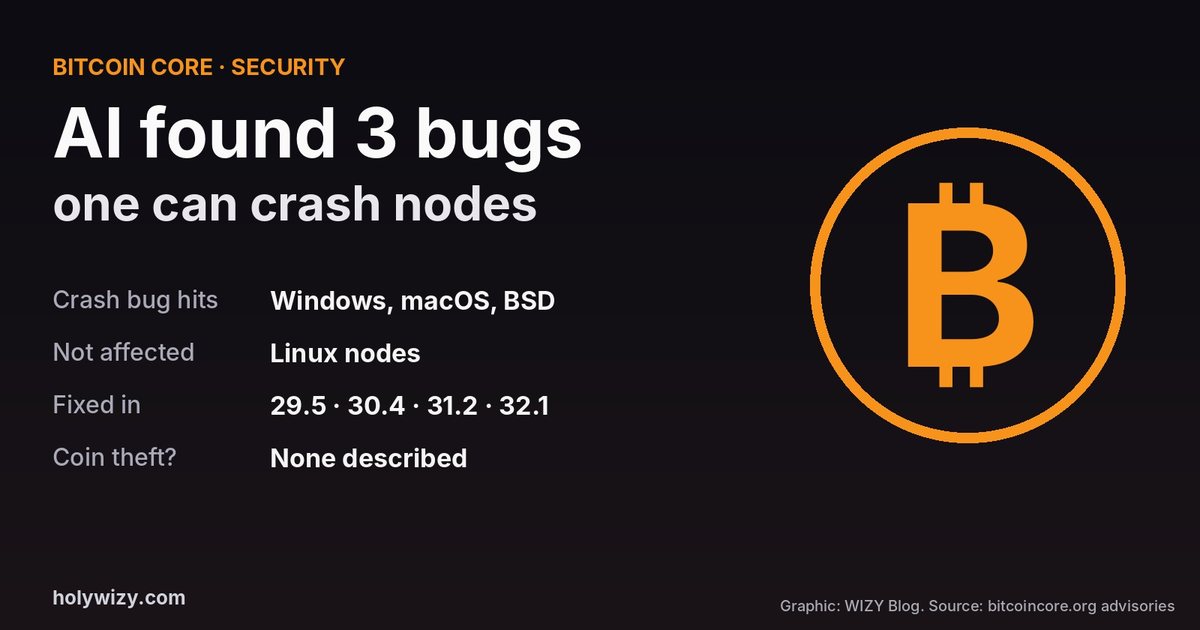
Bitcoin Core, the software that runs most of the Bitcoin network, has disclosed three bugs found with the help of an AI scanner. The most serious one lets a connected peer crash a node running on Windows, macOS or BSD by filling up its memory. Fixes are already out. Here's what happened, who's affected, and whether Bitcoin itself is in danger.
This page has affiliate links: if you buy through them, WIZY may earn a small commission at no extra cost to you. As an Amazon Associate I earn from qualifying purchases.
The key facts
- Disclosed: October 28, 2026, in three advisories on bitcoincore.org.
- Fixed versions: Bitcoin Core 29.5, 30.4, 31.2 and 32.1. Versions 31.2 and 32.1 came out on October 27, and 29.5 and 30.4 on October 28.
- Found by: two of the three bugs were surfaced by Project Loupe, a free AI vulnerability scanner for open-source Bitcoin projects built by Elias Rohrer at Spiral. Developer Gregory Sanders validated the findings and reported them to the Bitcoin Core security team.
The three bugs
- Node crash on Windows, macOS and BSD (medium severity): a connected peer can send a special kind of network data ("TCP urgent data") that makes the node keep using more and more memory until it crashes. Linux nodes are not affected.
- Slow memory growth (medium severity): a second issue involving very old-style peers that can make a node's memory use grow over time.
- Undo-file overflow (low severity): a storage bug that the advisory says only matters under impractical conditions. Reports say a version of it remains on 32-bit systems and on drives using the FAT32 file system.
Is Bitcoin in danger?
Not in the way the headlines might suggest. These bugs can knock individual nodes offline or affect their storage; none of the advisories describe a way to steal coins or change the blockchain. Reports differ on whether anyone has used the crash bug in the wild: one says no exploitation has been seen, while others note the advisories don't say either way. The real risk is to people running their own node on Windows or a Mac who don't update.
Why this came out so fast
Bitcoin Core used to keep medium-severity bugs secret for up to a year while fixes rolled out. Since October 22, bugs the project judges "easily discoverable" (the kind an AI scanner can find cheaply) get a quick fix across supported versions and a public advisory at the same time. The idea: if anyone can find the bug with a scan, hiding it only slows down the defenders. These three are the first bugs disclosed under the new rule, and CoinDesk reports three more medium- and high-severity bugs, already fixed in Bitcoin Core 30.0, are expected to be disclosed in about two weeks.
What node runners should do
- Check your version. If you're on Windows, macOS or BSD and running anything older than the fixed versions above, update.
- Download only from the official site, bitcoincore.org, and fully shut down Bitcoin Core before installing.
- Note that the 29.x branch is end-of-life: 29.5 includes these fixes but won't get future ones, so plan a move to a newer version.
If you just hold Bitcoin on an exchange or a hardware wallet and don't run a node, there's nothing you need to do.
My take
An AI finding real bugs in Bitcoin Core sounds scary, but the outcome here is the system working: the bugs were found, fixed and disclosed quickly, and no coins are at risk. The bigger worry is how many node runners never update. If you run a node on Windows or a Mac, this is your reminder. Do you run your own node?
This is news, not financial advice.
Sources
- Bitcoin Core: Unbounded memory growth through TCP urgent data on non-Linux systems bitcoincore.org
- CoinDesk: AI found a way to crash bitcoin nodes on Windows and Macs coindesk.com
- TFTC: Bitcoin Core discloses three AI-found bugs under new fast-track rules tftc.io
- Crypto Briefing: Bitcoin Core bug lets malicious peers crash Windows and Mac nodes cryptobriefing.com
- AMBCrypto: Bitcoin Core patches 3 node-crashing bugs ambcrypto.com
- Project Loupe projectloupe.org

Written by the WIZY creator
An independent builder on Monad, working on the WIZY project and the WIZY RPG game. I write about crypto in plain English and about the games I care about, and I check every fact against its source.