
We may earn a commission from links on this page.
The Aeldari are one of the oldest races in Warhammer 40,000. Long ago they ruled most of the galaxy, then their own excesses gave birth to a Chaos God, and their empire was destroyed almost overnight. What is left of them is proud, clever and slowly dying. Here is how they fell, how the survivors live now, and why they still matter. If you want something to read along the way, the classic Path of the Eldar novels are a good place to start.
Lore page, last updated November 15, 2026. Summarised in our own words from codexes, campaign books and Black Library novels. Much of Aeldari history comes from their own myths, so some of it may be legend rather than fact. You may also see the name "Eldar", which means the same people. Funnily enough, "Aeldari" is actually the older of the two names. Where the lore differs, we say so.
The Aeldari in 30 seconds
| What they are | An ancient, long-lived and highly psychic alien race |
| Other name | The Eldar, the name used after the Fall and in the game until 2017 |
| The disaster | The Fall, when their excesses gave birth to Slaanesh |
| When | Around the turn of the 31st millennium (M31), around the time of the Emperor's Great Crusade |
| What it left behind | The Eye of Terror, where their homeworlds used to be |
| Main branches | Craftworlds (Asuryani), Drukhari, Exodites, Harlequins and Ynnari |
| Famous names | Eldrad Ulthran, Prince Yriel, Yvraine, the Phoenix Lords |
| Biggest fear | Slaanesh, who waits to eat their souls when they die |
An empire that ruled the stars
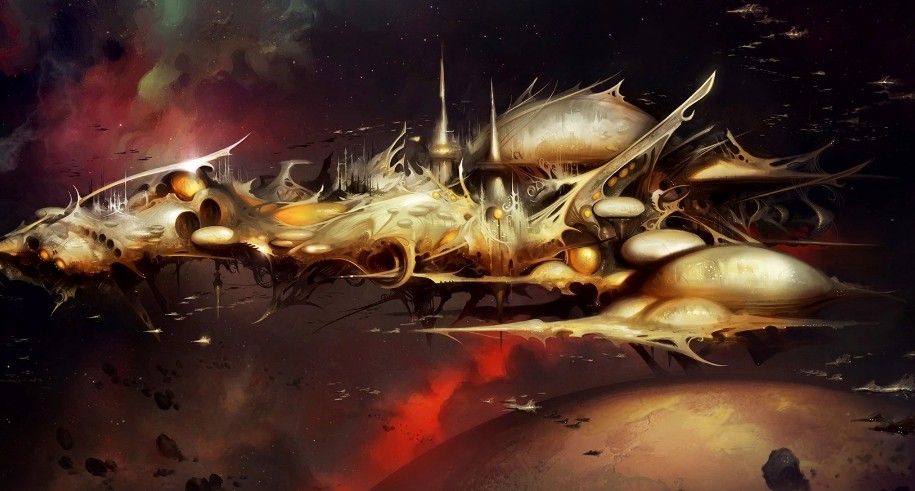
Long before humans reached the stars, the Aeldari ruled a huge part of the galaxy. They were created by the Old Ones as living weapons for the ancient War in Heaven against the C'tan and their Necrons. They also helped the Old Ones build the Webway, a hidden network of tunnels through the warp that lets them travel between stars quickly and safely. When the war was over, the Aeldari took over from the Old Ones as masters of the galaxy, and no other race was strong enough to threaten them.
The Aeldari usually live for well over a thousand years and feel everything far more strongly than humans do. Joy, grief, anger and pleasure all hit them harder. With no enemies left to fight and machines to do all the work, their society slowly turned to chasing new sensations. Pleasure cults spread, then turned cruel and violent, and the whole empire sank into excess.
The Fall and the birth of Slaanesh
Like everything in Warhammer, the emotions of living beings echo into the warp. Millennia of Aeldari excess gathered there and took shape as a new Chaos God: Slaanesh, the Prince of Pleasure. When it was finally born, around the turn of the 31st millennium, the psychic shock killed most of the Aeldari in an instant and tore a hole in reality where their home worlds had been. That wound is the Eye of Terror, still the largest warp storm in the galaxy.
The Aeldari gods were mostly destroyed in the same event. Slaanesh devoured almost all of them. Khaine, the god of war, fought back and was shattered into pieces. Cegorach, the Laughing God, escaped by hiding in the Webway. Lexicanum counts those two as the only survivors. Some myths say Isha, the mother goddess, was saved too, but the lore is not clear on this.
An odd side effect: the blast also cleared away the warp storms that had cut humanity off for generations, which helped make the Emperor's Great Crusade possible. The Aeldari's darkest day opened the door for humanity's rise.
Worst of all, every Aeldari soul now belongs to Slaanesh. When one dies, the Prince of Pleasure is waiting to consume it. Everything about the Aeldari way of life since the Fall is shaped by that one terrible fact.
The survivors
Only some of the Aeldari survived, and they split into very different groups:
- The Craftworlds (Asuryani): giant ships that fled the empire before or during the Fall. Each is a whole world drifting through space.
- The Exodites: Aeldari who saw the rot early and left to live simple lives on far-off frontier worlds, often riding giant beasts.
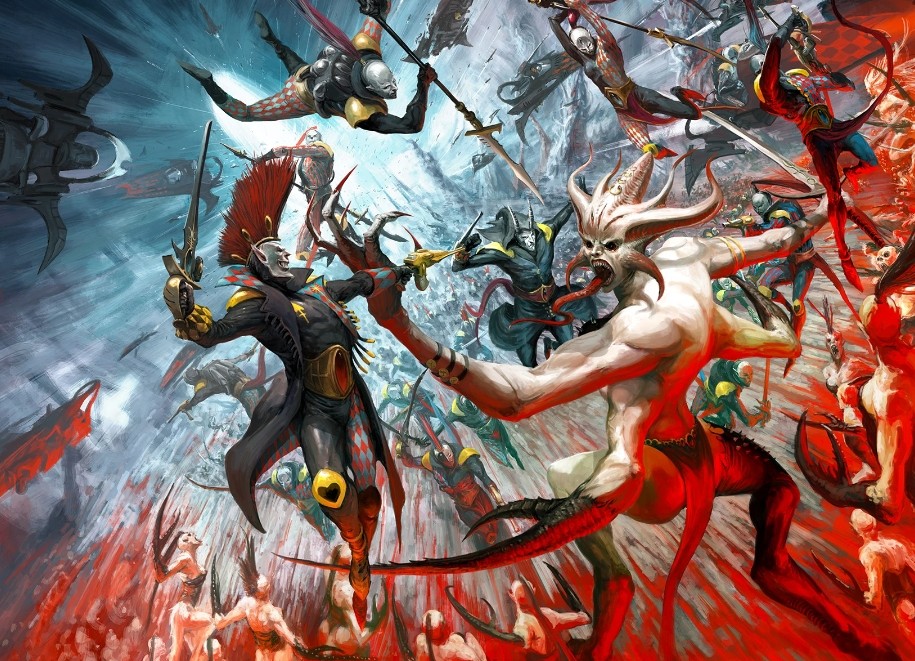
- The Drukhari: those who hid in the Webway city of Commorragh. They never gave up their cruelty, and now survive by feeding on the pain of others.
- The Harlequins: warrior-performers who serve Cegorach and travel the Webway, acting out the myths of their people. Their most important job is guarding the Black Library, a secret archive hidden in the Webway.
Life on a craftworld
The craftworld Aeldari are the ones most people mean by "the Aeldari". To protect themselves from Slaanesh and from their own dangerous emotions, they live by the Path. An Aeldari spends years, even decades, mastering one role at a time: a poet, an engineer, a pilot, a warrior. When one path is done, they move on to another. This keeps them focused and stops them sliding back into excess.
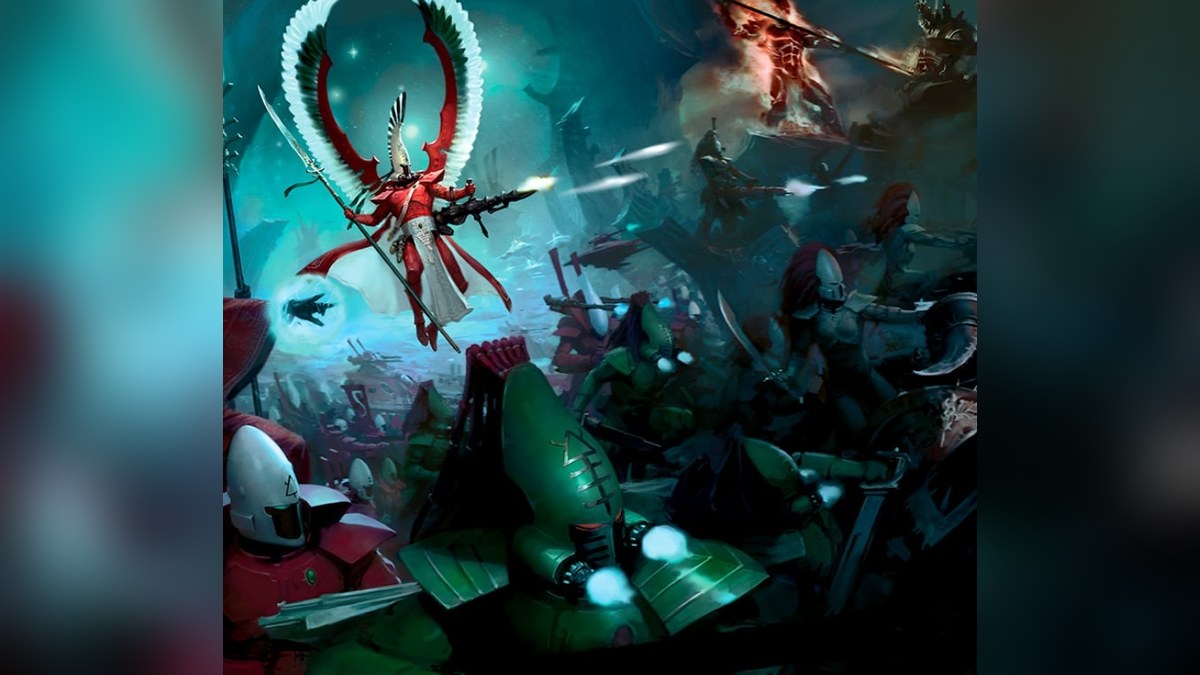
The warrior paths are the Aspect Warriors, each shaped around a different side of the war god Khaine, such as the Dire Avengers or the Howling Banshees. The founders of each shrine are the Phoenix Lords, ancient heroes who keep coming back to life in their armour. The first of them is Asurmen. Some Aeldari get stuck on a path forever and become Exarchs. Others leave the paths altogether and become Outcasts: rangers, pirates and wanderers.
Every craftworld Aeldari wears a spirit stone. When they die, the stone catches their soul before Slaanesh can, and it is placed in the craftworld's infinity circuit, a psychic network inside the wraithbone that holds the souls of the dead. In hard times the dead are even placed in robot bodies to fight again as Wraithguard and Wraithlords. Craftworld Iyanden is said to have built the first infinity circuit around the 33rd millennium, and the idea then spread to the other craftworlds.
In each craftworld also sleeps an Avatar of Khaine, a burning iron giant that holds a fragment of the shattered war god. When war comes, the Aeldari wake it, and it leads them into battle.
Famous craftworlds and heroes
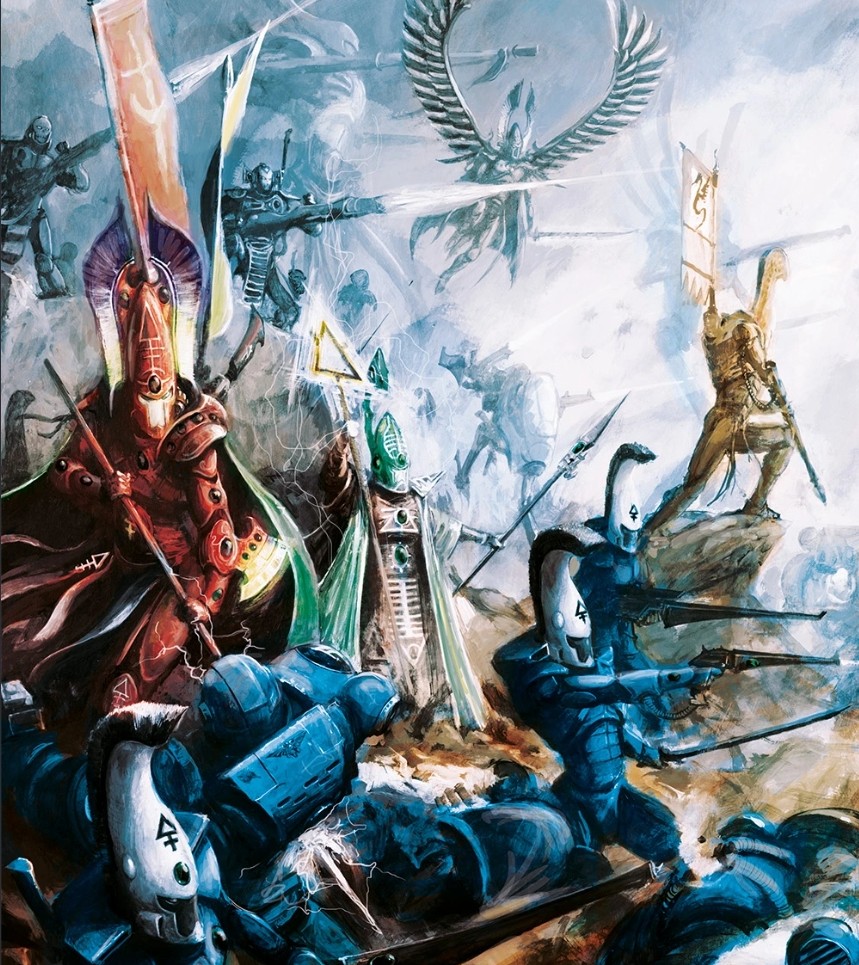
There are many craftworlds, each with its own character. Ulthwé got caught in the pull of the Eye of Terror and now orbits it. Living next door to Chaos has given it lots of psychics and a standing army known as the Black Guardians. Biel-Tan wants to rebuild the old empire by force. Saim-Hann is famous for its jetbike riders, the Wild Riders. Biel-Tan's elite army is called the Swordwind. Alaitoc is strict about the paths and has produced many rangers. Iyanden was nearly destroyed by Hive Fleet Kraken of the Tyranids, losing most of its people, and now fights with many of its dead in wraith bodies. Its exiled pirate prince, Yriel, came home just in time to help save it.
The best-known Aeldari character is Eldrad Ulthran, the great farseer of Ulthwé. Farseers read the paths of the future and act to steer them, often by sacrificing humans or other races to save Aeldari lives. That habit is a big part of why the Imperium does not trust them. You can follow his rules and model in Codex: Aeldari.
A new hope: Ynnead and the Ynnari
The Aeldari have one hope of escaping Slaanesh forever: Ynnead, a god of the dead. The idea is that once every Aeldari has died, all their souls together will form a new god strong enough to defeat Slaanesh. Eldrad spent a long time trying to wake Ynnead early.
In the Gathering Storm era, a Drukhari gladiator named Yvraine was reborn as the Emissary of Ynnead. Her followers are the Ynnari, Aeldari from every branch who walk together. Yvraine also played a part in waking Roboute Guilliman, an alliance few in the Imperium were comfortable with. Some Aeldari see the Ynnari as salvation. Others think they are a dangerous cult. The lore leaves it open, though for now the Ynnari are still a small minority among the Aeldari.
Yvraine believes Ynnead can be woken by finding the five Crone Swords, ancient blades once given to servants of the old Aeldari gods, and putting them in the right hands. The Ynnari have found four so far. The last one was left behind on Belial IV, where Shalaxi Helbane, a daemon of Slaanesh, took it to the Palace of Slaanesh.
Odd facts about Aeldari bodies and minds
Aeldari look a lot like tall, slim humans with pointed ears, but on the inside they are very different. Their hearts beat twice as fast as ours, their reactions are far quicker, and every one of their senses is sharper. They can even hear sounds too high or too low for human ears. Children are rare, with a new generation only every few centuries, so every birth is a big deal. Twins and triplets are treated as fated, and many end up crewing Aeldari Titans together. Farseers can live for several thousand years, until all that psychic work slowly turns them into crystal.
Their lost homeworld, now inside the Eye of Terror, had three moons named after their gods and heroes: Lileath the white Maiden Moon, Kurnous the dim green Hunter's Moon and Eldanesh the Red Moon.
The Aeldari on the tabletop
On the tabletop, the Aeldari are a fast, elite army of specialists. Each unit does one job very well, which rewards careful play. The Aeldari Combat Patrol is a good starting box, and our Aeldari faction guide goes through how to begin.
Where to read more
- Path of the Warrior (Gav Thorpe): an Alaitoc artist joins the Striking Scorpions. The best way to understand the Path. It continues in Path of the Seer and Path of the Outcast.
- Valedor (Guy Haley): craftworlds join forces against the Tyranids.
- Rise of the Ynnari: Ghost Warrior (Gav Thorpe): Yvraine and the first steps of the Ynnari.
- Codex: Aeldari: the rules plus background on the craftworlds, Harlequins and Ynnari.
FAQ
What is the difference between Eldar and Aeldari?
None, they are the same people. "Aeldari" was the name the whole race used for itself before the Fall. After the Fall they called themselves "Eldar". Games Workshop brought "Aeldari" back in 2017 as the name for the whole race, and "Asuryani" now means the craftworld branch.
What caused the Fall of the Aeldari?
Their society's endless pursuit of pleasure built up in the warp until it gave birth to Slaanesh. The god's birth wiped out their empire and created the Eye of Terror.
Why do the Aeldari wear spirit stones?
To keep their souls safe from Slaanesh. The stone catches the soul at death, and it joins the craftworld's infinity circuit.
Are the Drukhari Aeldari?
Yes. They are the same people, but they chose a different way to survive: hiding in Commorragh and feeding on the suffering of others.
More lore: read about the Chaos Gods, the Necrons, the Tyranids, Roboute Guilliman and the Great Rift.
Lore summarised in our own words from Black Library novels, codexes and community wikis. Warhammer and all related names are trademarks of Games Workshop; WIZY is an independent fan site.
Sources
- Goonhammer: Lore Explainer, The Fall of the Aeldari goonhammer.com
- Lexicanum: Eldar History wh40k.lexicanum.com
- Lexicanum: Craftworld Eldar wh40k.lexicanum.com
- Lexicanum: Eldrad Ulthran wh40k.lexicanum.com
- Lexicanum: Ynnari wh40k.lexicanum.com
- Warhammer Community: Who are the Phoenix Lords? warhammer-community.com
Spot a mistake or know something we missed?
Tell us below. Only we see it, and we fix the page.