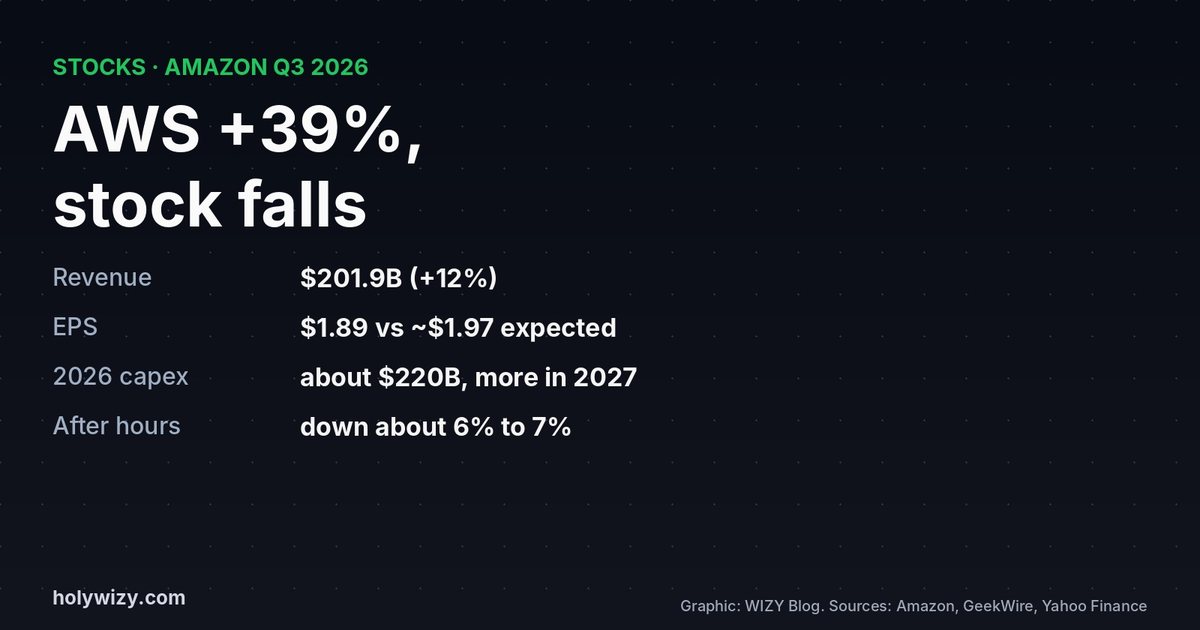
Amazon reported its third-quarter 2026 results after the market closed on October 29. AWS, its cloud business, grew 39%, its fastest pace in nearly five years. But profit per share missed estimates, cash flow turned sharply negative, and Amazon said it will spend even more on AI next year. The stock fell about 6% to 7% after hours. It capped a day when worries about AI spending also hit Caterpillar.
This is news, not financial advice. Do your own research before buying or selling any stock.
Amazon's numbers
- Revenue: $201.9 billion, up 12% from $180.2 billion a year ago (13% excluding currency changes).
- AWS: $46.0 billion, up 39%. AWS operating income was $17.8 billion, up from $11.4 billion.
- North America: $112.9 billion, up 6%. International: $43.1 billion, up 5% (8% excluding currency).
- Operating income: $28.1 billion, up from $17.4 billion.
- Earnings per share: $1.89, below the roughly $1.96 to $1.97 analysts expected and down from $1.95 a year ago. Net income was $20.7 billion. Reports point to higher interest costs on Amazon's growing debt and other losses.
- Free cash flow (last 12 months): an outflow of $42.4 billion, compared with an inflow of $14.8 billion a year earlier.
The AI spending question
Amazon plans about $220 billion of capital spending in 2026, much of it on data centers and AI. According to GeekWire, CEO Andy Jassy said Amazon expects to spend "meaningfully more" in 2027, that AWS has a $578 billion backlog of contracted future revenue, and that he expects AWS growth to top 40% in 2027 and 2028.
That's the split investors are weighing: AWS demand is clearly strong, but the bill keeps growing and cash flow has gone deeply negative.
Guidance for the holiday quarter
- Revenue: $240.0 billion to $247.0 billion, growth of 12% to 16%.
- Operating income: $28.5 billion to $33.5 billion, compared with $25.0 billion in the fourth quarter of 2025.
The stock
Amazon shares had already closed down 4.25% at $243.79 in the regular session, a weak day for big tech after Alphabet's report. After the results, they fell roughly another 6% to 7% in after-hours trading, according to live coverage from Yahoo Finance and GeekWire. After-hours moves can change by the next open.
Caterpillar: a beat, but the stock fell
Earlier on October 29, Caterpillar showed the same pattern. According to its earnings release, revenue rose 17% to $20.7 billion and adjusted earnings per share were $7.20, above estimates of about $7.03 to $7.08. It also reported a record $78 billion backlog, but it kept its full-year growth forecast unchanged and pointed to "moderate" growth in the fourth quarter. The stock fell sharply, with reported drops of roughly 8% to 12% during the day.
Why it matters
This week, Alphabet, Amazon and Caterpillar all showed the same thing: strong demand linked to AI, and a market that is now focused on how much that build-out costs and when it pays off. For the Alphabet and Microsoft side of the story, read Alphabet falls, Microsoft rises.
My take
AWS growing 39% at Amazon's size is remarkable, and a $578 billion backlog says the demand is real. But a $42 billion cash outflow and "meaningfully more" spending next year is exactly what makes investors nervous right now. Do you think the AI spending will pay off for Amazon?
Sources
- Amazon: Amazon.com announces third quarter results ir.aboutamazon.com
- GeekWire: AWS growth hits 39%, its fastest in nearly five years, as Amazon misses on earnings geekwire.com
- Yahoo Finance: Amazon earnings live finance.yahoo.com
- The Motley Fool: Stock market today, Oct. 29, Amazon falls on Q3 earnings and capex concerns fool.com
- Caterpillar Q3 2026 earnings release (SEC) sec.gov
- TipRanks: Caterpillar stock dives after earnings tipranks.com
- Investing.com: Caterpillar tops Q3 2026 estimates, shares drop in.investing.com

Written by the WIZY creator
An independent builder on Monad, working on the WIZY project and the WIZY RPG game. I write about crypto in plain English and about the games I care about, and I check every fact against its source.