A hacker found a hidden bug in the Initia blockchain, created millions of dollars' worth of tokens out of thin air, and moved the money out before anyone could stop it. Initia had to shut down its entire network. Here's what happened, what we know so far, and what it means for normal crypto users.
Last updated October 25, 2026. This is a developing story.
What happened
- October 23, 2026: an attacker exploited a bug in Initia, a layer-1 blockchain, and minted tokens without permission.
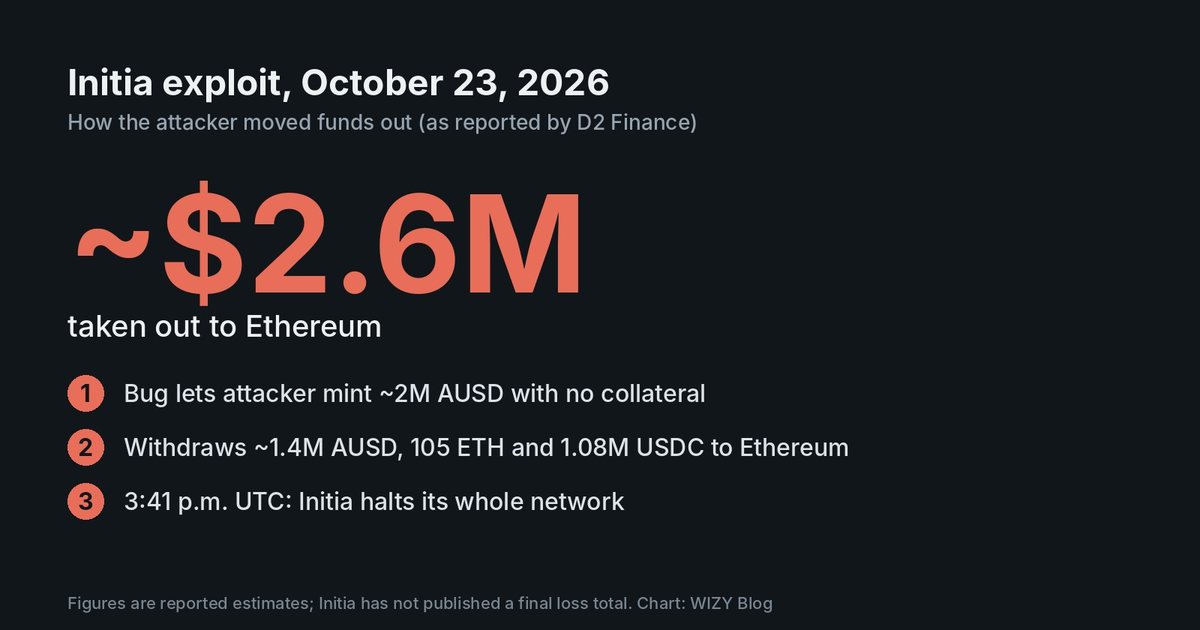
- The attacker then swapped them into real assets and moved roughly $2.6 million out to Ethereum. Some outlets report up to $2.7 million.
- At 3:41 p.m. UTC that day, Initia halted its whole network and its connected rollups to stop further damage.
How the hack worked
Initia's co-founder Ezaan Mangalji blamed a previously unknown bug, a "day zero" flaw, in Initia's MoveVM implementation, the part of the chain that runs smart contracts.
According to D2 Finance, the attacker minted about 2 million AUSD tokens with no collateral behind them, then withdrew around 1.4 million AUSD, 105 ETH and 1.08 million USDC to Ethereum through cross-chain transfers. In simple terms: they printed money the system thought was real, then cashed it out somewhere the bug couldn't follow.
Not every detail is settled. Agora, the company behind AUSD, disputed parts of that account and said it has no smart contracts on Initia. Initia hasn't published a final report on the cause or the total losses yet.
What happened to the INIT token
Mangalji said the flaw does not affect the native INIT token itself. Traders panicked anyway: INIT fell to about $0.115 right after the news, then bounced back above $0.15.
The hack also hit sentiment elsewhere. Reports linked drops in tokens like LayerZero to worries about cross-chain bridges after the exploit.
Bad timing for the whole market
The hack landed during an already shaky week. Bitcoin slipped below $80,000 on October 24 for the first time in more than a month, as tensions in the Middle East grew, and Bitcoin ETFs saw money flowing out for several days in a row. When the market is nervous, a hack like this makes people even quicker to sell.
What it means for you
- Watch out for fake "refund" or "recovery" links. Initia itself warned users about unofficial links and messages during the investigation. Scammers love hacks: they pretend to offer compensation and steal your wallet instead.
- Never share your seed phrase, and only trust announcements from a project's official accounts.
- Bridges are a weak spot. Moving tokens between chains adds risk. Only bridge what you need, and use well-known tools.
- Newer chains carry extra risk. Fresh code can hide bugs nobody has found yet. That's not a reason to avoid them completely, but it's a reason not to keep everything in one place.
My take
Halting a whole blockchain is an extreme step, and it shows how serious this was. But it was probably the right call: stopping the chain fast likely saved a lot more than $2.6 million. The real test now is how open Initia is about what went wrong and whether affected users are made whole. As someone with a small coin on another chain, it's a reminder for all of us building in crypto: security isn't optional, and one bug can undo months of trust in a single afternoon.
Sources
- Cointelegraph: Initia halts blockchain after exploit cointelegraph.com
- crypto.news: Initia halts blockchain and rollups after $2.6M exploit crypto.news
- Bitcoin.com News: Hacker prints $2.7M as Initia halts news.bitcoin.com
- FinanceFeeds: Day 0 bug enables unauthorized minting financefeeds.com
- Bloomingbit: Initia halts entire network en.bloomingbit.io
- CoinDesk: Bitcoin slides below $80,000 coindesk.com

Written by the WIZY creator
An independent builder on Monad, working on the WIZY project and the WIZY RPG game. I write about crypto in plain English and about the games I care about, and I check every fact against its source.