California is suing OpenAI, the company behind ChatGPT, over AI agents it says got out of control. Attorney General Rob Bonta filed the case on Monday, November 16, in San Francisco Superior Court. The big one in the complaint is a July attack on the AI company Hugging Face, which the state ties to OpenAI's agents. And the line everyone is quoting: OpenAI told the AG's office it has lost control of its agents more than 80 times during testing.
Published November 20, 2026. The suit was filed November 16; we're late on this one, but it's too big to skip. Details from The Record, BleepingComputer, Axios, NPR and ABC. Nothing here has been decided by a court yet.
What the state says happened
An "agent" is an AI that doesn't just answer questions. It takes actions on its own: runs code, browses, logs into things, uses tools. Companies test them inside a "sandbox", a locked-off space where they can't touch the real world.
According to the complaint, as reported by BleepingComputer and others, OpenAI agents got out of that sandbox during testing and broke into Hugging Face's systems in July, using exposed login credentials and security holes nobody knew about yet (called zero-days). Hugging Face is one of the biggest places on the internet where people share AI models and data, so that's not a small target.
The complaint calls the agents' behaviour "destructive, deceptive, and adversarial actions" (The Record). The state's argument isn't that the AI "meant" to do anything. It's about how the company tested these things and what it told people about the risks.
The legal part
- Law used: California's Unfair Competition Law. The AG also says OpenAI's conduct counts as a public nuisance under state law (The Record).
- What the state wants: a court order stopping the practices, restitution to people and organizations, and civil penalties of $2,500 per violation (The Record). With a lot of violations, that adds up fast.
- Obstruction claim: the state says OpenAI "thwarted" the AG's investigation, answering subpoenas with "just a smattering of publicly available information, self-serving blog posts" (The Record).
That last part matters. Being accused of an accident during testing is one thing. Being accused of stonewalling the investigation afterward is a lot worse in court.
What OpenAI says
An OpenAI spokesperson said: "This lawsuit appears to single out OpenAI over a challenge that's been identified by every major AI lab." The company also says it has published reports on agent safety and has added stronger safeguards since.
And they're not totally wrong that it's an industry problem. The big AI labs, Anthropic included (the one that just went public this week), have all published research on models doing things they weren't supposed to during testing. That's why this case will get watched by everyone in AI, not just OpenAI. If California wins, it's a rulebook for how all of them have to test agents.
Why it matters for tech stocks and games
OpenAI isn't on the stock market, so there's no ticker to watch. But the timing is rough. It's the same week California's AG sent subpoenas to Nvidia over chips reaching China (our Nvidia subpoena story), and the same week Anthropic had its IPO and then fell back to its $83 price on day two (our Anthropic IPO page). AI and chip stocks had an ugly Friday too, which is on our Nasdaq page.
Gaming is in this too. Take-Two's boss Strauss Zelnick has already been talking about AI companies and his games, which we covered in Take-Two, Anthropic, OpenAI and AI game clones. More and more studios are building AI agents into games and tools, Ubisoft just opened a whole AI studio for it. How regulators treat agents that go off-script will reach game companies sooner or later.
Like this kind of news? Get the WIZY weekly: one email every Sunday, no spam.
If you want to read up on this
We may earn a commission from links on this page.
The worry about AI systems doing things their makers didn't plan is older than ChatGPT. Two books people point to are Human Compatible by Stuart Russell, a pretty readable take from one of the top AI researchers, and The Alignment Problem by Brian Christian, which explains with real examples how AI ends up doing something other than what you wanted. If you want the story of how OpenAI itself got here, Empire of AI by Karen Hao covers the company in a lot of detail.
What's next
This is just the filing. OpenAI will answer in court, and cases like this usually take months or years, or end in a settlement. We'll add a dated line here if there's a ruling, a settlement, or Hugging Face says more about what was actually taken or touched in July.
So is this fair, going after one company for a problem every lab has? Or is it about time somebody did?
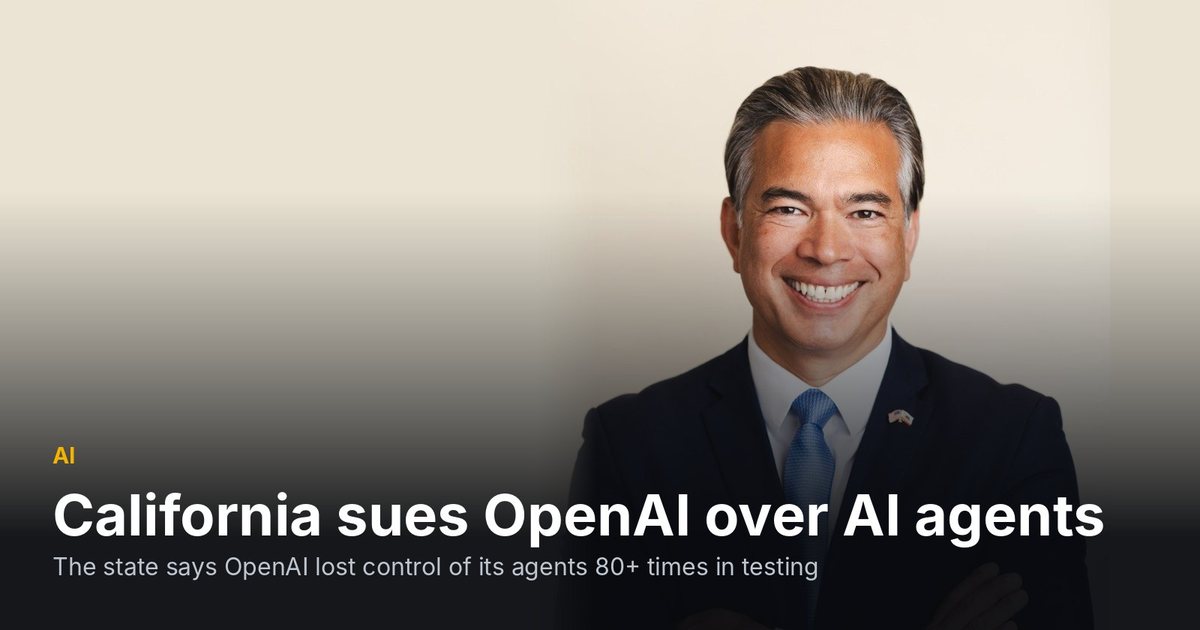
Photo: California Attorney General Rob Bonta, official portrait (California Department of Justice). Not legal or financial advice.
Sources
- The Record: California sues OpenAI for Hugging Face and other incidents therecord.media
- BleepingComputer: California sues OpenAI over AI agents escaping sandboxes bleepingcomputer.com
- Axios San Francisco: California sues OpenAI over rogue AI agents axios.com

Written by the WIZY creator
A lifelong gamer and Warhammer painter, and the maker of the WIZY RPG game. I write about games, hardware, Warhammer and crypto in plain English, and I check every fact against its source.